Metroidbrainia
Progression is gated by what you understand, not what you grind. Learn IP math, deduce network topologies, master terminal syntax — your own knowledge is the only real key in the network.
A Wild West built on salvaged tech.
A top-down cybersecurity investigation RPG where the internet is a place you walk — and you are the one who learned how it actually works.
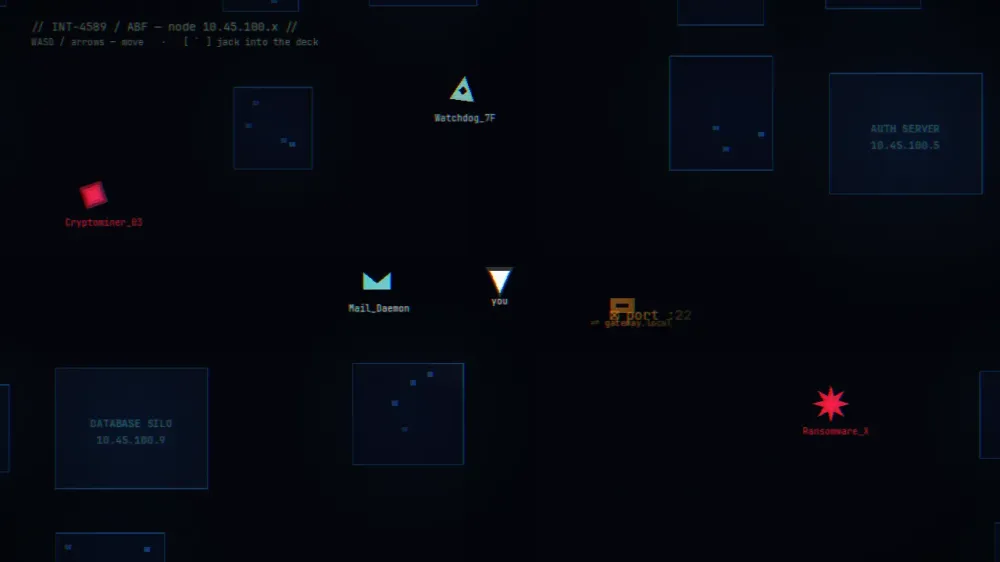
The old Internet is gone — drowned when the mega-corporations handed it to AI. What’s left is the World Wide Wonder: a salvaged, human-built network stitched together across Sector INT-4589/ABF. A frontier of duct-tape tech, where every town is a server cluster and every monster is a process doing exactly what it was told.
You play a Purple-team netrunner — equal parts attacker and defender — moving node to node through a procedurally generated topology. Combat isn’t a brawl; it’s an investigation. Probe a daemon, read its logs, fingerprint its weakness, then compile the single exploit that unmakes it.
It’s a Metroidbrainia: nothing gates your progress except your own understanding of how the network really works.
[DESIGN PILLARS]
Progression is gated by what you understand, not what you grind. Learn IP math, deduce network topologies, master terminal syntax — your own knowledge is the only real key in the network.
No health bars. Time pauses; you probe and fingerprint a daemon to expose its archetype, trigger, and weakness, then compile the one payload that actually counters it. Arco-style simultaneous resolution.
The UI is the character. A slide-up terminal and draggable OS windows; real commands — arpspoof, ssh, scp, kill -9 — do real work. No radial menus, no inventory scrolls.
Cross the dark Veil as a ghost in hostile cyberspace. Open the terminal and the world tilts, zooms, and ignites into the Focus diorama. Seizing control literally lights the world.
Every Accord aligns to the cybersecurity colour wheel. Reputation is an SSL-style web of trust: earn a faction’s signature and doors open; get caught and you land on their revocation list.
The world has no undo. A reckless kill -9 on an innocent process, a ransomware timer you let run out — that data is gone for good. Precision is the difficulty curve.
[VERTICAL SLICE]
One node, start to finish — captured from the working prototype.
// INT-4589 / ABF — node 10.45.100.x
Connect to an IP and the map drops you into a top-down pixel world. Firewalls are walls, databases are vaults, malware wears a body. This is the Veil: a near-black cyberspace where blue server buildings and hostile daemons glow as thin neon glyphs.
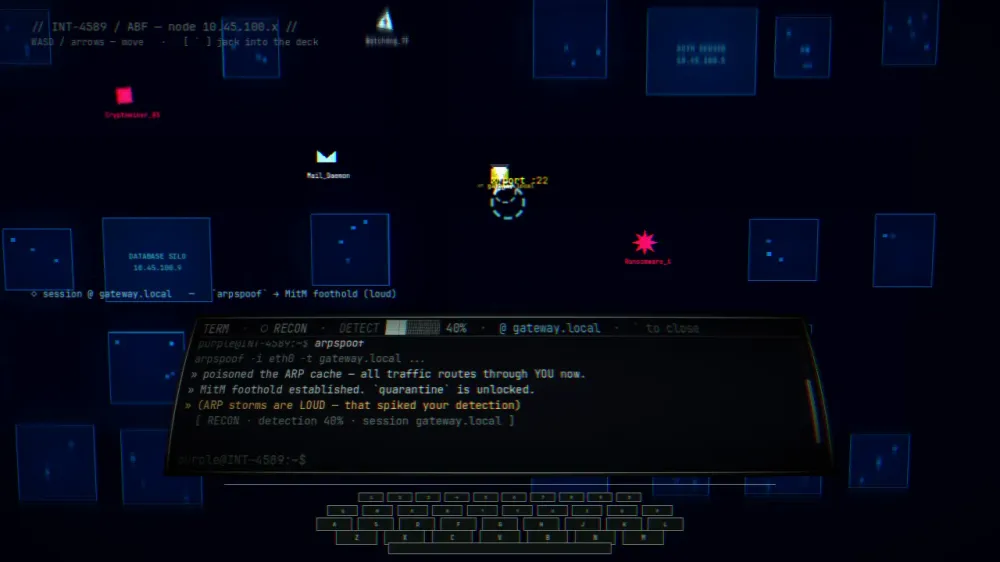
arpspoof -i eth0 -t gateway.local
Hit the gateway and the terminal slides up — the world brightens into the Focus diorama. Poison the ARP cache and every packet routes through you. It works, but ARP storms are loud: your detection meter spikes, and the node starts watching back.
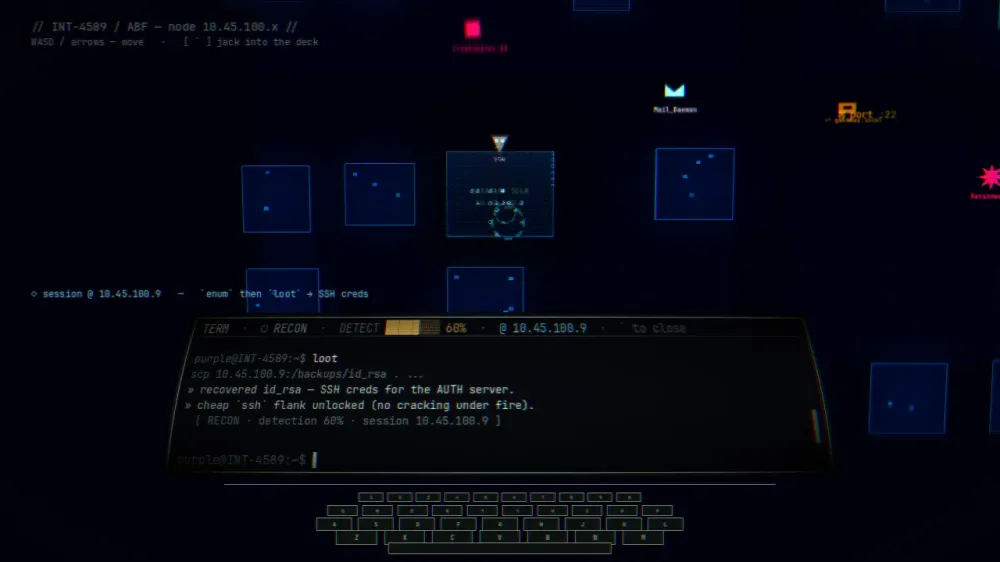
scp 10.45.100.9:/backups/id_rsa .
Information is asymmetry. Pull an id_rsa off a database silo and you have SSH credentials for the AUTH server — a cheap flank you can take without cracking anything under fire. Every command is a real technique doing a real thing.
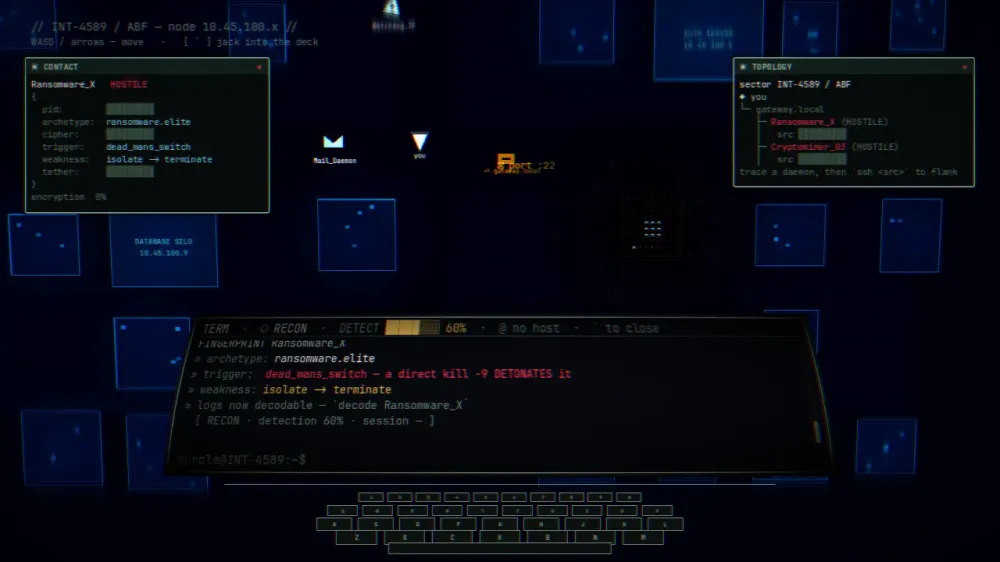
fingerprint Ransomware_X
Investigation is the study; combat is the exam. Fingerprinting reveals the archetype — ransomware.elite — its trigger (a dead-man’s switch: a raw kill -9 detonates it) and its weakness (isolate, then terminate). Now you know how to win before the fight begins.
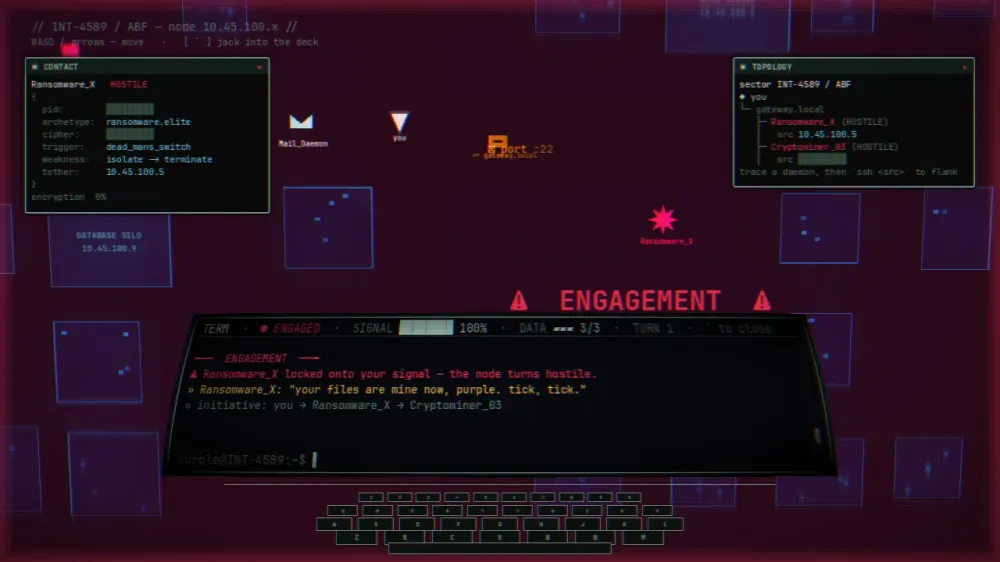
ENGAGEMENT · SIGNAL 100% · DATA 3/3
The node locks onto your signal and the screen floods red. Diegetic CONTACT and TOPOLOGY windows lay out the enemy and the wire. You don’t have HP — you have Signal Integrity; you don’t have mana — you have Data Packs. Turn order is initiative on the network.
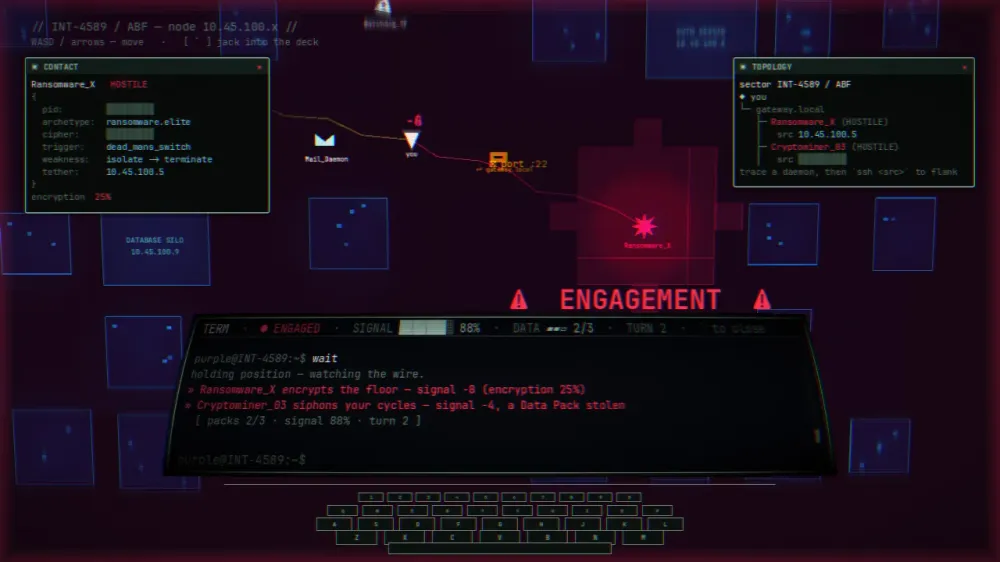
wait — watching the wire · TURN 2
The ransomware encrypts the floor tile by tile; a cryptominer siphons your cycles and steals a Data Pack. Quarantine it, starve it, spoof it, or pin its PID — every threat has multiple solutions, and the wrong one gets loud.
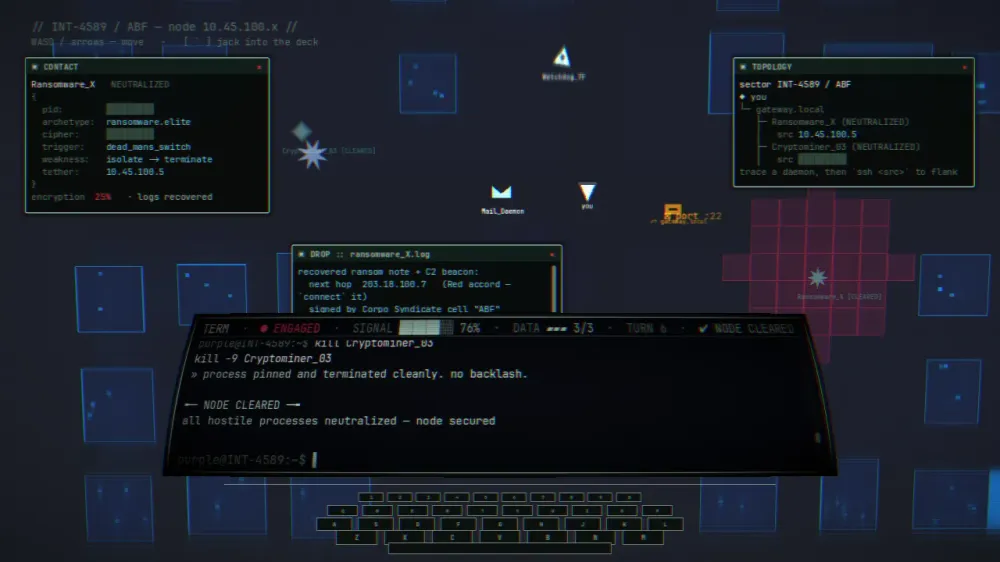
kill -9 Cryptominer_03 — node secured
Pin the process, terminate it clean, no backlash. Hostile daemons desaturate to grey as your white control-pulse overwrites their colour. NODE CLEARED — and the recovered logs drop something heavier than loot.
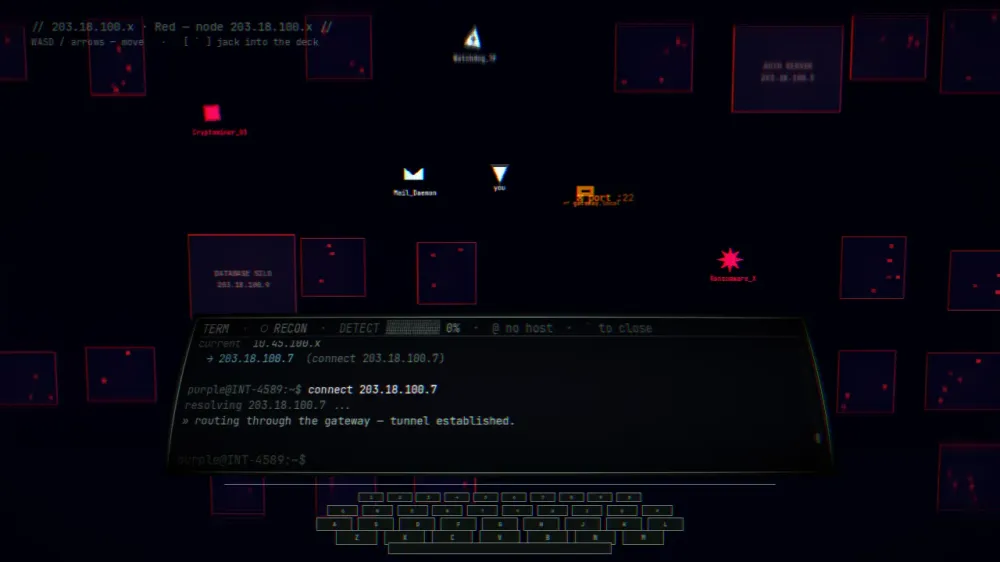
connect 203.18.100.7 — tunnel established
The ransom note is signed by a Corpo Syndicate cell; its C2 beacon points one hop deeper into a Red accord. Connect, and the whole node renders in hostile red — faction is identity, painted into every wall. The investigation never really ends; it escalates.
[THE COLOUR WHEEL]
The world maps to the real cybersecurity colour wheel. Hue is who someone is — painted into their towns, their daemons, their walls — and it never lies, even from across the dark.
Defense
Fortified, gridded bastions ringed by firewall ramparts. Safe-ish — if your certificate checks out.
Offense
Angular predatory spires and choke points. The flood originates here. Owned, hostile turf.
Operations
Pipes, conduits, automation arms. They run the backbone; cross them and your bandwidth throttles.
Education
Signal towers, archives, broadcast dishes. Buy threat intelligence and decrypt lore in their halls.
The commons
Markets, mixed dwellings, lantern-lit crowds — and your own starting identity. Where everyone meets.
Reserved hues — not factions
Not a faction — the vanished Builders of the old Internet. Seeing yellow means you found something old. Relic, ruin, sacred and rare.
Absent governance — and your own control signal. A white pulse sweeping a node is you overwriting whoever owned it.
[THE THREAD]
Clear a node and the loot rarely ends the story — it deepens it. The ransom note you recover is signed by a Corpo Syndicate cell, its beacon pointing one hop deeper into the network. The Syndicate are the remnants of the old-world giants that drowned the first Internet — and they’re back to harvest human data all over again.
You don’t pull that thread alone. Kumo, a cheerful little assistant AI, rides along to handle the busywork — bookmarks, fast-travel, the auto-mapper — so you can keep your eyes on the wire. In a network this hostile, every netrunner learns the same lesson eventually: trust is a certificate, and certificates can be forged.
$ wishlist --platform=steam
Targeting Steam Next Fest, October 2026. Follow the build in the garden.